

HACCP and Food Safety Management: Best Practices for the Food Industry
Food safety is the most important part of the food business. Great packaging doesn't matter if the food makes people sick. A delicious recipe doesn't matter if the product is unsafe.
Factories used to check quality at the very end. They would make a thousand cans of soup. Then they would test just one. The batch shipped if that one can was okay. This system was bad. It relied on luck.
We use a better system today. It is called HACCP food safety. This system uses science. It stops problems before they start. It looks at every single step of the process.
You need to understand this system whether you run a bakery or a big factory. It is the global language of safety. You can see this system in action at SIAL China. This is the biggest food and beverage show in Asia. It connects you with the experts and tools you need.
This guide explains the best practices for safety. We will show you how to build a strong food safety plan and why it helps you succeed.
What is HACCP Food Safety?
The name sounds hard. It stands for Hazard Analysis Critical Control Point. But the idea is simple.
HACCP is a science-based, systematic approach that identifies specific hazards and measures for their control to ensure the safety of food. According to the Codex Alimentarius (International Food Standards), the system is designed to focus on prevention rather than relying mainly on end-product testing.
HACCP food safety asks two questions:
- What can go wrong? (Hazard Analysis)
- How do we stop it? (Critical Control Points)
NASA started this system in the 1960s. They needed safe food for astronauts. They couldn't risk food poisoning in space. According to NASA's history on food safety innovation, they created hazard analysis critical control point haccp food safety rules to ensure 100% safety for the space program.
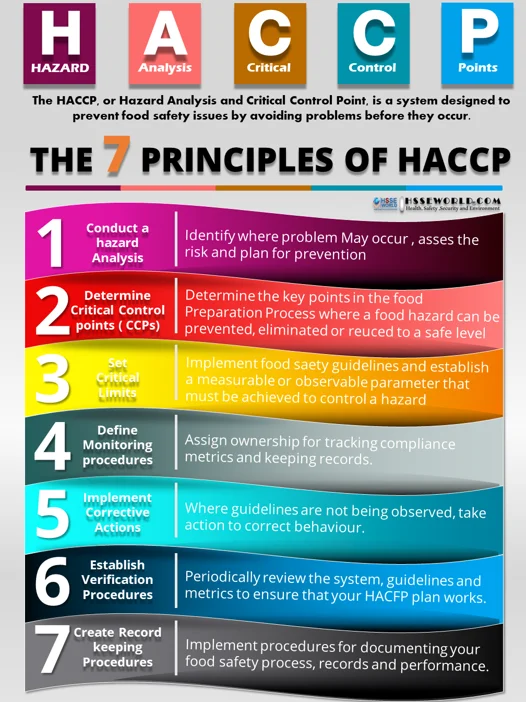
The 7 Principles of Hazard Analysis Critical Control Point HACCP Food Safety
You have to follow seven specific steps to build a working system. These are the seven principles.
Principle 1: Conduct a Hazard Analysis
You have to play detective first. Look at your whole process. Start with the ingredients. End with the final product. You are looking for hazards.
Hazards are usually three things:
- Biological: Bacteria like Salmonella.
- Chemical: Cleaners or allergens like peanuts.
- Physical: Glass or metal pieces.
List every danger you find. Then decide which ones are likely to happen.
Principle 2: Determine Critical Control Points (CCPs)
This is the core of your food safety plan. A Critical Control Point (CCP) is a step where you fix a problem.
Think about cooking chicken. Raw chicken has bacteria. Cooking kills the bacteria. So, the cooking step is a Critical Control Point. You remove the hazard if you cook it right.
Principle 3: Establish Critical Limits
You need a rule for your CCP. We call this a Critical Limit.
Don't just tell staff to "cook it well." That is too vague. You need a number. For example: "Cook to 165°F (74°C) for 15 seconds." This is a clear line. One side is safe. The other side is unsafe.
Principle 4: Establish Monitoring Procedures
You have a rule. Now you need to check it. This is monitoring.
You need to define the details.
- What: Measuring temperature.
- How: Using a digital thermometer.
- Who: The line cook.
Monitoring proves your haccp safety food system works in real-time.
Principle 5: Establish Corrective Actions
What if the temperature is too low? You need a plan immediately. This is a Corrective Action.
You might decide to keep cooking the meat. You might decide to throw it away. Decide this before the problem happens. Your staff will know exactly what to do. They won't panic.
Principle 6: Establish Verification Procedures
Monitoring checks the food. Verification checks the system.
Is the thermometer accurate? Is the cook writing down the truth? A manager reviews the logs. Verification makes sure your hazard analysis critical control point haccp food safety plan is real.
Principle 7: Record Keeping and Documentation
Write everything down. If you didn't write it, it didn't happen. Auditors love paperwork. Keep records of everything.
- Temperature logs.
- Training records.
- Cleaning schedules.
Good records defend you. You can open your files and prove you did everything right if a customer complains.For official templates and more detailed definitions of these principles, you can refer to the FDA’s HACCP Principles & Application Guide.
Building Your Food Safety Plan
HACCP is the engine. But the food safety plan is the whole car. You need a strong foundation.
Source: HSSE World - The 7 Principles of HACCP
The Environment Matters
You cannot make safe food in a dirty factory. Fix your facility before you look for hazards.
- Pest Control: Keep rats and flies out.
- Sanitation: Clean floors and machines on a schedule.
- Personal Hygiene: Staff must wash hands and wear hairnets.
- Supplier Control: Buy only from trusted sources.
You can find experts in these areas at SIAL China. Exhibitors sell industrial cleaners and high-tech pest control systems.
Assembling the Team
Don't do this alone. You need a team. Include people from production. Include engineers. Include cleaners.
Everyone sees the factory differently. An engineer sees a leaking pipe. A cleaner sees dirt in a corner. Working together creates a better haccp food safety strategy.
Why HACCP Safety Food Standards Matter for Trade
We live in a global economy. Ingredients travel across oceans. A product might have spices from one country and meat from another.
Meeting Global Standards
Different countries have different laws. But almost all recognize hazard analysis critical control point haccp food safety.
- USA: The law requires a plan like HACCP.
- China: The food safety laws are very strict.
- Europe: Regulations demand it.
You need to speak this language to grow. You meet international buyers when you exhibit at SIAL China. They will ask if you are certified. A certified food safety plan builds trust instantly. Most international regulations are aligned with the standards set by the Codex Alimentarius (International Food Standards).
Protecting Your Brand Reputation
Building a reputation takes years. Ruining it takes minutes. Bad news travels fast on social media.
A strong haccp safety food system protects you. It stops recalls. It saves you money. It protects your brand name.
Technology and Innovation in Food Safety
Old HACCP methods used paper and clipboards. Technology is changing the game today. You can see this at SIAL China.
Digital Monitoring
Imagine a freezer that texts you if it gets warm. Sensors can replace manual checks. These sensors record data 24/7. They send reports to the cloud. This stops human error.
Blockchain for Traceability
Blockchain helps food safety too. It creates a digital record of every step. You can trace bad bacteria back to a farm in seconds. This speed saves lives.
You can see this tech at the "Global Food Industry Summit" during SIAL China. Companies show how software simplifies your food safety plan.
Best Practices for Implementation
Knowing the rules is one thing. Following them is another. Here are tips to make it work.
Create a Food Safety Culture
This is the most important tip. A plan on paper fails if staff don't care.
Safety starts at the top. The boss must care. Employees will wash their hands if the boss does. Encourage people to speak up. A worker should feel safe reporting a problem.
Continuous Training
Training is not a one-time event. People forget. Rules change.
Train your team often. Keep it short. Explain the "why." Explain that gloves stop sickness. People follow haccp food safety rules when they understand the reason.
Review and Update
Your factory changes. Maybe you bought a new machine. Maybe you changed a recipe.
Review your hazard analysis critical control point haccp food safety plan when you change something. Does the new machine add a hazard? Audit your system at least once a year.
How SIAL China Supports Safety Management
Regulations can be confusing. You don't have to navigate them alone. SIAL China helps the industry.
Access to Expertise
Professionals come from all over the world. You can talk to consultants. They specialize in haccp safety food certification. They can explain Chinese laws.
Sourcing Equipment
You need tools to implement your plan. You might need color-coded cutting boards. You might need metal detectors. SIAL China has huge halls filled with suppliers. You can find the right tools there.
Networking with Peers
Other business owners give great advice. Meet them at SIAL China. Ask how they handle their food safety plan. Learn from their mistakes.
Conclusion
Food safety is a requirement. It is a promise you make to your customers.
The HACCP food safety system helps you keep that promise. It prevents problems. It uses science and discipline.
Implementing the 7 principles of hazard analysis critical control point haccp food safety takes work. But it is worth it. Your factory runs better. You waste less. You get peace of mind.
The industry moves fast. Visit SIAL China to stay ahead. You will find answers in Shanghai whether you need a new food safety plan or new tech. Protect your customers. Protect your brand. Use these best practices and watch your business grow.

'/%3e%3cdefs%3e%3clinearGradient%20id='paint0_linear_1477_4631'%20x1='18.272'%20y1='0'%20x2='18.272'%20y2='35.3674'%20gradientUnits='userSpaceOnUse'%3e%3cstop%20stop-color='%23FF9F9F'/%3e%3cstop%20offset='1'%20stop-color='%23F15E5E'/%3e%3c/linearGradient%3e%3c/defs%3e%3c/svg%3e)
'/%3e%3cdefs%3e%3clinearGradient%20id='paint0_linear_1477_4633'%20x1='17.5'%20y1='0'%20x2='17.5'%20y2='35'%20gradientUnits='userSpaceOnUse'%3e%3cstop%20stop-color='%23E9C0EE'/%3e%3cstop%20offset='1'%20stop-color='%23CE57DC'/%3e%3c/linearGradient%3e%3c/defs%3e%3c/svg%3e)

