
'%3e%3cpath%20d='M10%200C4.4772%200%200%204.4772%200%2010C0%2014.6896%203.2288%2018.6248%207.5844%2019.7056V13.056H5.5224V10H7.5844V8.6832C7.5844%205.2796%209.1248%203.702%2012.4664%203.702C13.1%203.702%2014.1932%203.8264%2014.6404%203.9504V6.7204C14.4044%206.6956%2013.9944%206.6832%2013.4852%206.6832C11.8456%206.6832%2011.212%207.3044%2011.212%208.9192V10H14.4784L13.9172%2013.056H11.212V19.9268C16.1636%2019.3288%2020.0004%2015.1128%2020.0004%2010C20%204.4772%2015.5228%200%2010%200Z'%20fill='black'/%3e%3c/g%3e%3cdefs%3e%3cclipPath%20id='clip0_601_545'%3e%3crect%20width='20'%20height='20'%20fill='white'/%3e%3c/clipPath%3e%3c/defs%3e%3c/svg%3e)

'%3e%3cpath%20d='M18.5195%200H1.47656C0.660156%200%200%200.644531%200%201.44141V18.5547C0%2019.3516%200.660156%2020%201.47656%2020H18.5195C19.3359%2020%2020%2019.3516%2020%2018.5586V1.44141C20%200.644531%2019.3359%200%2018.5195%200ZM5.93359%2017.043H2.96484V7.49609H5.93359V17.043ZM4.44922%206.19531C3.49609%206.19531%202.72656%205.42578%202.72656%204.47656C2.72656%203.52734%203.49609%202.75781%204.44922%202.75781C5.39844%202.75781%206.16797%203.52734%206.16797%204.47656C6.16797%205.42188%205.39844%206.19531%204.44922%206.19531ZM17.043%2017.043H14.0781V12.4023C14.0781%2011.2969%2014.0586%209.87109%2012.5352%209.87109C10.9922%209.87109%2010.7578%2011.0781%2010.7578%2012.3242V17.043H7.79688V7.49609H10.6406V8.80078H10.6797C11.0742%208.05078%2012.043%207.25781%2013.4844%207.25781C16.4883%207.25781%2017.043%209.23438%2017.043%2011.8047V17.043Z'%20fill='black'/%3e%3c/g%3e%3cdefs%3e%3cclipPath%20id='clip0_601_548'%3e%3crect%20width='20'%20height='20'%20fill='white'/%3e%3c/clipPath%3e%3c/defs%3e%3c/svg%3e)
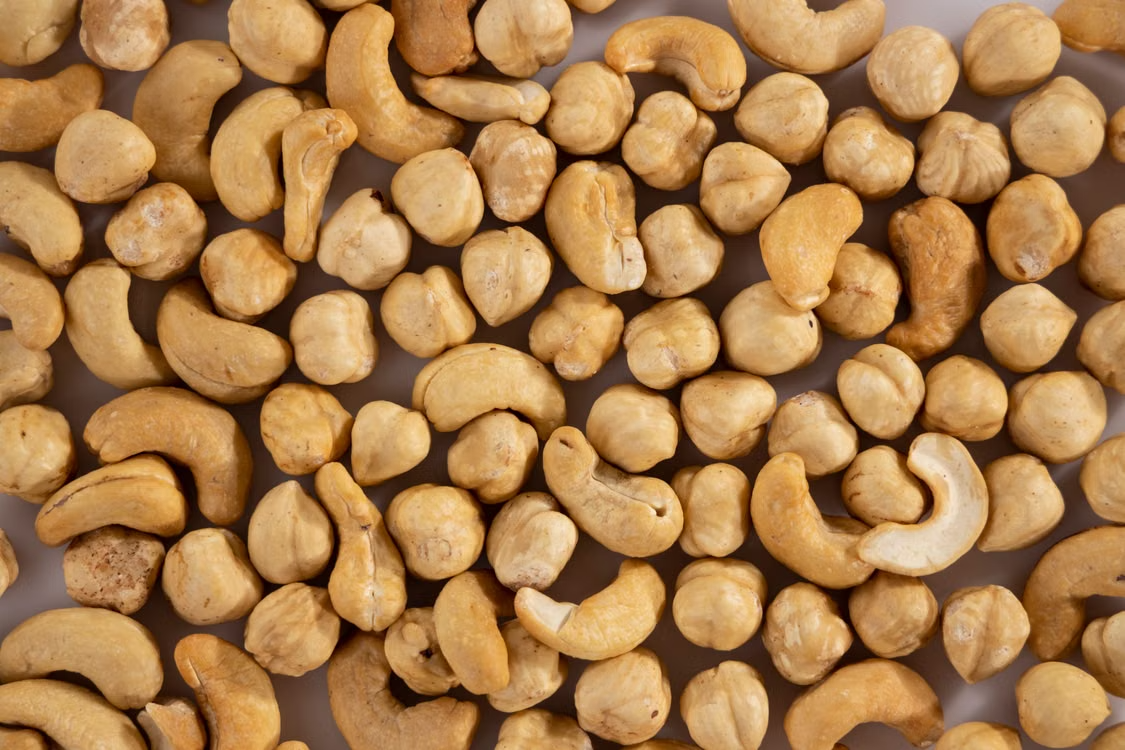
The U.S. market relies heavily on imported cashew nuts for snack foods, food manufacturing, nut mixes, confectionery, and private-label products. For international suppliers, winning wholesale business requires more than competitive pricing. Buyers typically evaluate kernel size, grade, defects, moisture, food-safety controls, documentation, consistency, and delivery reliability before approving a supplier. This guide explains the U.S. purchasing landscape, major cashew product types, quality considerations, import requirements, and the practical steps international buyers can use to evaluate a reliable cashew nuts supplier.
Key Item | Details |
|---|---|
Product Category | Tree Nuts (Shelled Raw Kernels, Roasted/Flavored Kernels, In-Shell Raw Cashew Nuts) |
Target Market | The United States |
Tariff (2026) |
|
Primary Regulatory Agencies | |
Key U.S. Import Compliance Requirements |
|
Defect Tolerance Limit | FDA CPG Sec. 570.425: Maximum 5% total reject limit for shelled cashews |
Last Updated | September 2026 |
U.S. Cashew Market Landscape & Sourcing Demand
Sourcing Drivers Across Consumer and Industrial Sectors
The U.S. market for imported cashew nuts has expanded beyond traditional snack nut mixes. While packaged roasted and salted whole cashews remain a staple in grocery aisles, significant demand growth is driven by food ingredient innovation:
- Plant-Based Dairy Alternatives: Food manufacturers utilize broken grades (butts, splits, and pieces) to produce cashew milk, vegan cheeses, ice creams, and plant-based butter due to the cashew’s mild flavor and high fat solubility.
- Nutritional Bar & Snack Manufacturing: Confectionery and energy bar brands utilize raw whole and piece kernels for texture and clean-label protein enrichment.
- Private-Label Retail: Supermarket chains actively seek direct relationships with a reliable cashew nuts supplier to maintain consistent shelf supply for private-label lines.
Key Pain Points in Wholesale Procurement
Navigating cashew nuts wholesale procurement involves several supply chain challenges:
- Quality and Grade Inconsistency: Moisture variations or improper sorting at origin can result in brittle kernels, discoloration, or off-flavors during transit.
- Mycotoxin & Contamination Risks: Aflatoxin contamination caused by unmanaged post-harvest humidity poses severe food safety hazards.
- Regulatory Import Detentions: Shipments failing FDA physical inspection or lacking proper Foreign Supplier Verification Program (FSVP) documentation face immediate detention or refusal at U.S. ports of entry.
Cashew Product Types, Sizing, and Quality Standards
Cashew specifications can vary significantly by product form, kernel size, grade, and intended use. For U.S. wholesale sourcing, buyers should define these requirements clearly so suppliers can quote the right product and consistently meet the agreed quality specifications.
1. Select the right product form
Cashews entering the U.S. market may be supplied in several forms:
- In-shell cashews, generally sold for specific processing or specialty uses.
- Shelled raw cashew kernels, widely used as wholesale ingredients.
- Roasted cashews, including dry-roasted and oil-roasted products.
- Salted or flavored cashews, supplied for snack and retail applications.
- Broken or smaller kernel pieces, often used in food manufacturing where appearance is less important.
For international suppliers, the product description should be precise. “Cashew nuts” is not enough for a commercial quotation. A U.S. buyer will normally want to know whether the product is raw or roasted, shelled or in-shell, whole or broken, and what size or count specification applies.
2. Use size and grade specifications consistently
Commercial cashew trading frequently uses size designations such as W240 and W320 for whole kernels. These designations are based on the approximate number of kernels per pound and help buyers communicate expected kernel size consistently.
Whole kernels are commonly categorized by count per pound (454 grams):
- W180 (Super Jumbo): 170–180 kernels/lb
- W210 (Jumbo): 200–210 kernels/lb
- W240: 220–240 kernels/lb
- W320: 300–320 kernels/lb
- W450: 400–450 kernels/lb
For reference, the USDA Agricultural Marketing Service (AMS) commercial specification for shelled, roasted nuts incorporates the UNECE DDP-17 standard and provides specific requirements for cashew kernels covered by that procurement specification.
- Source Link: https://www.ams.usda.gov/sites/default/files/media/CID%20Nuts%2C%20Shelled%2C%20Roasted.pdf
- Original Text:
- § 5.1.3 Cashews: The cashew kernels must be of the “Extra” class of the United Nations Economic Commission for Europe (UNECE) Standard DDP‑17.
- TABLE II: Count of shelled raw nuts Cashew Type III or IV 454 g (1.0 pound): Min 220, Max 320.
The USDA specification therefore provides a useful reference for understanding how cashew quality and count requirements may be expressed in a formal procurement document. However, it should not be presented as a mandatory U.S. grade standard for ordinary private-sector trade. It is a USDA commercial item description used for government procurement, and its requirements apply when the relevant procurement specification calls for them.
For normal private-sector wholesale transactions, buyers and suppliers may instead establish their own size, grade, defect, moisture, and other quality requirements in the purchase contract.
3. Control visible and food-safety defects
FDA's CPG Sec. 570.425 defines relevant “rejects” to include insect infestation, moldy, rancid, decomposed, blank, and shriveled nuts. For cashews, the listed regulatory-action criterion is 5% for shelled nuts, while no numerical percentage is provided for in-shell cashews in that table.
- Source Link: https://www.hhs.gov/guidance/document/cpg-sec-570425-tree-nuts-adulteration-involving-rejects-insect-infestation-moldy-rancid
- Original Text: This guidance document represents the Agency's current thinking on its enforcement process concerning the adulteration of tree nuts involving rejects (insect infestation, moldy, rancid, otherwise decomposed, blanks, and shriveled). It does not create or confer any rights for or on any person and does not operate to bind FDA or the public. An alternative approach may be used if such approach satisfies the requirements of the applicable statute and regulations.
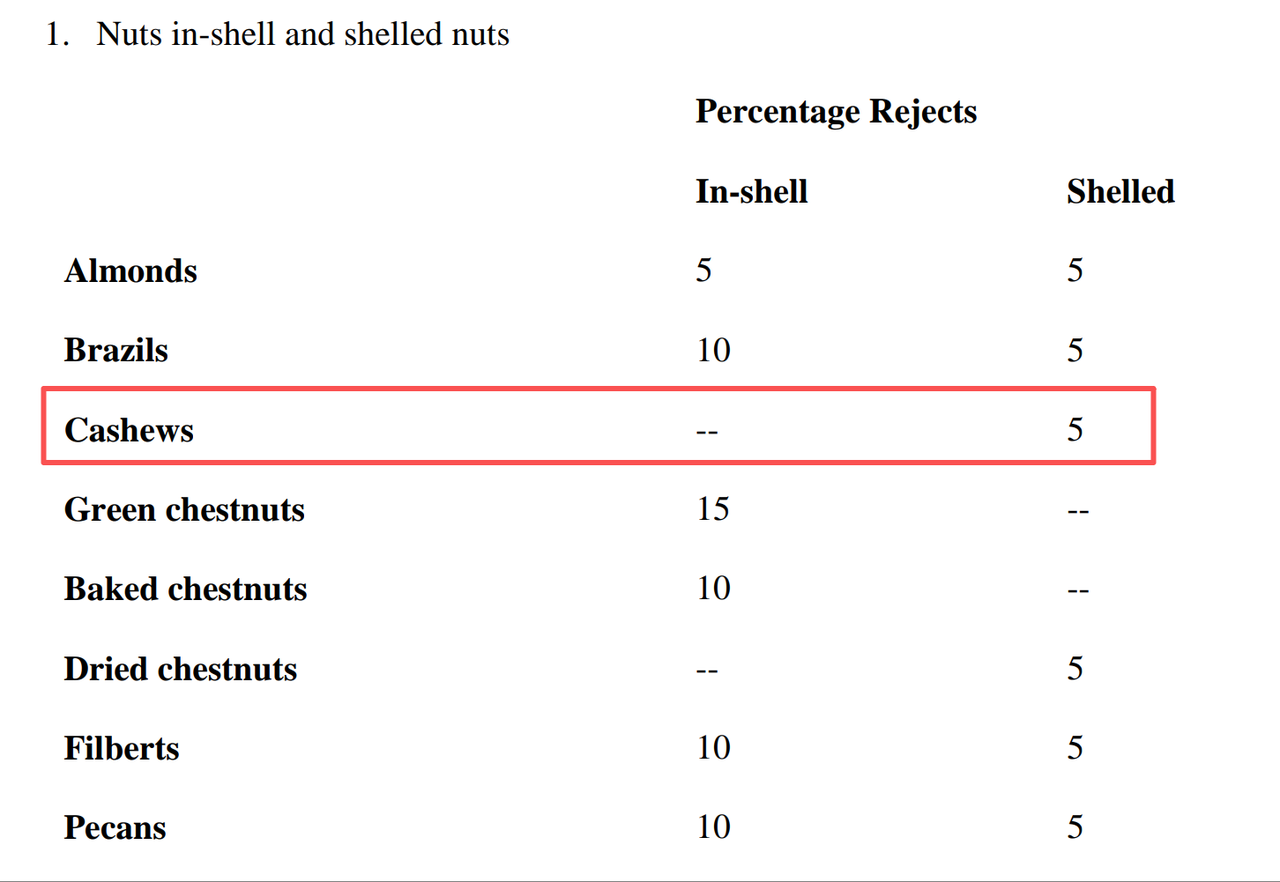
This is an enforcement policy guide rather than a mandatory product-grade specification. Nevertheless, suppliers should treat the 5% figure as an important FDA compliance benchmark when designing quality-control procedures for shelled cashews.
Federal Regulatory Landscape & Sourcing Standards
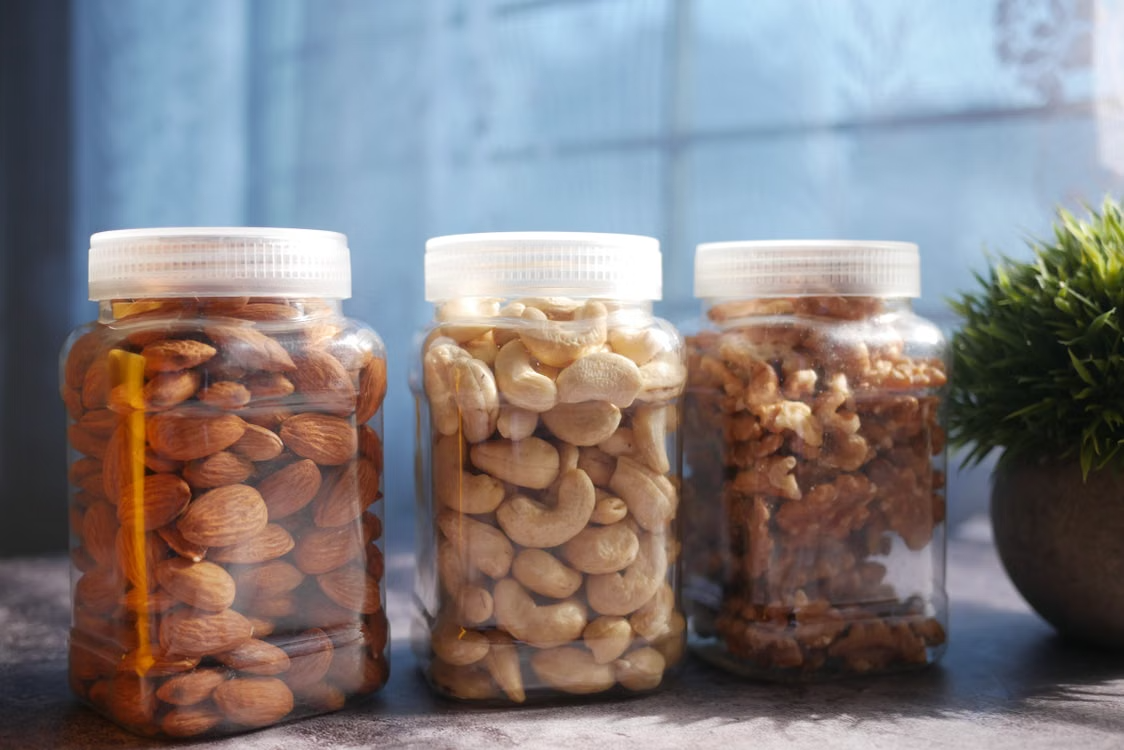
U.S. cashew imports should be subject to multiple federal food-safety, plant-health, labeling, and customs requirements depending on the product, processing status, origin, and transaction.
1. FDA Food Safety Modernization Act (FSMA)
- Regulatory Basis: 21 CFR Part 112 (Produce Safety Rule)
- Source Link: https://www.ecfr.gov/current/title-21/chapter-I/subchapter-B/part-112
- Original Text: § 112.1(a): Unless it is excluded from this part under § 112.2, food that is produce within the meaning of this part and that is a raw agricultural commodity (RAC) is covered by this part. This includes a produce RAC that is grown domestically and a produce RAC that will be imported or offered for import in any State or territory of the United States, the District of Columbia, or the Commonwealth of Puerto Rico. Covered produce includes tree nuts, including cashews.
- Supplier Implication: Foreign food facilities that manufacture, process, pack, or hold food for consumption in the United States may be subject to FDA food facility registration and applicable FSMA food-safety requirements. For imported cashews, the specific FDA rule depends on the product and facility activity. The U.S. importer, not the foreign supplier, is generally responsible for establishing and maintaining the required FSVP, while suppliers may need to provide records supporting that verification.
2. FDA Standardized Tree Nut Products Definition
- Regulatory Basis: 21 CFR Part 164 (Standardized Tree Nut Products)
- Source Link: https://www.ecfr.gov/current/title-21/chapter-I/subchapter-B/part-164
- Original Text: § 164.110(b)(1): The optional shelled nut ingredients referred to in paragraph (a) of this section are: Almonds, black walnuts, Brazil nuts, cashews, English walnuts (alternatively “walnuts”), filberts, pecans, and other suitable kinds of tree nuts.
- Supplier Implication: This federal code formally classifies the cashew kernel as an authorized tree nut ingredient for standardized mixed nut products sold in U.S. commerce. While 21 CFR § 164.110 governs identity definitions for mixed nut formulations rather than raw whole cashew grades, it establishes the recognized legal commodity definition used across wholesale supply contracts and product declarations.
3. USDA APHIS Phytosanitary Entry Requirements
- Regulatory Basis: 7 CFR Part 319 (Foreign Quarantine Notices)
- Source Link: https://www.ecfr.gov/current/title-7/chapter-III/subchapter-P/part-319
- Core Information: Rule summary: APHIS requirements for nuts vary by commodity, processing status, and country of origin. Generally, dried, cured, cooked, or processed nuts may enter without an APHIS import permit or phytosanitary certificate, while shipments remain subject to inspection at U.S. ports of entry.
- Supplier Implication: Before exporting in-shell or minimally processed cashews, confirm the applicable APHIS requirements for the exact product form and country of origin. Do not assume that a requirement for one origin or processing condition applies universally. Where a phytosanitary certificate or other plant-health document is required, the supplier should arrange it through the competent authority in the exporting country before shipment.
4. FDA Food Allergen Mandatory Declaration
- Regulatory Basis: FDA Allergen Labeling (FALCPA, 21 U.S.C. 343(w))
- Source Link: https://www.govinfo.gov/content/pkg/USCODE-2022-title21/html/USCODE-2022-title21-chap9-subchapIV-sec343.htm
- Core Information: Tree nuts (including cashew) are defined as major food allergens. Any packaged cashew product sold in the US must clearly declare “cashew” on the label. Bulk wholesale cashews for further processing also need allergen declaration on shipping documents/pallet labels.
- Supplier Implication: Because cashews are legally classified as major tree nut allergens, suppliers should ensure that applicable packaged and bulk shipments carry the required allergen information. FDA allergen-labeling requirements can also apply to bulk containers used when food is shipped for further processing, labeling, or repacking. Suppliers should confirm the labeling format with the U.S. buyer and the applicable packaging arrangement before shipment.
5. Tariff Classification and Customs Valuation
- Regulatory Basis: Harmonized Tariff Schedule of the United States (HTSUS) — USITC & U.S. Customs and Border Protection
- Source Link: https://hts.usitc.gov/search?query=cashew
- Core Information: Cashew nuts are classified under heading 0801, with 0801.31.00 for in-shell cashews and 0801.32.00 for shelled cashews. The HTSUS general rate shown for the cashew provisions is 4.4¢/kg, while special tariff treatment can differ by country of origin.
- Supplier Implication: Suppliers should quote on an Incoterm basis that makes clear whether customs duties, brokerage, inspection, and other U.S. import charges are included. The importer should confirm the final classification and applicable tariff treatment before shipment. Do not treat the 4.4¢/kg figure as a universal landed cost because origin-specific or additional tariff measures may change the actual duty burden.
Import Restrictions and Practical Entry Risks
1. Do not assume all cashews face the same plant-health requirements
The distinction between in-shell and processed shelled kernels matters. APHIS requirements can vary according to commodity condition and origin, while FDA requirements apply to food imported for consumption.
This means a supplier should not build a blanket statement such as “all raw cashews require a phytosanitary certificate” into its U.S. compliance documentation. The correct approach is to verify the exact commodity, processing status, country of origin, and applicable APHIS conditions before loading.
2. Treat FDA inspection as a real commercial risk
FDA can examine imported food and take enforcement action when products are adulterated or misbranded. The agency's tree-nut compliance guide specifically identifies conditions such as insects, mold, rancidity, decomposition, blanks, and shriveled nuts as relevant defects.
Suppliers should therefore keep lot-level inspection and laboratory records rather than relying only on a general factory certificate. Documentation should be traceable to the actual production lot shipped to the U.S.
3. Align commercial specifications before production
U.S. buyers may impose specifications that are tighter than the regulatory minimum. For example, a buyer may set limits for moisture, defects, broken kernels, foreign material, color, microbiological parameters, pesticide residues, or mycotoxins.
A supplier that waits until after production to discover these requirements may face regrading, price deductions, replacement orders, or rejected cargo. The product specification should therefore form part of the purchase contract.
How to Choose the Right Cashew Nuts Supplier
1. Start with the buyer's actual specification
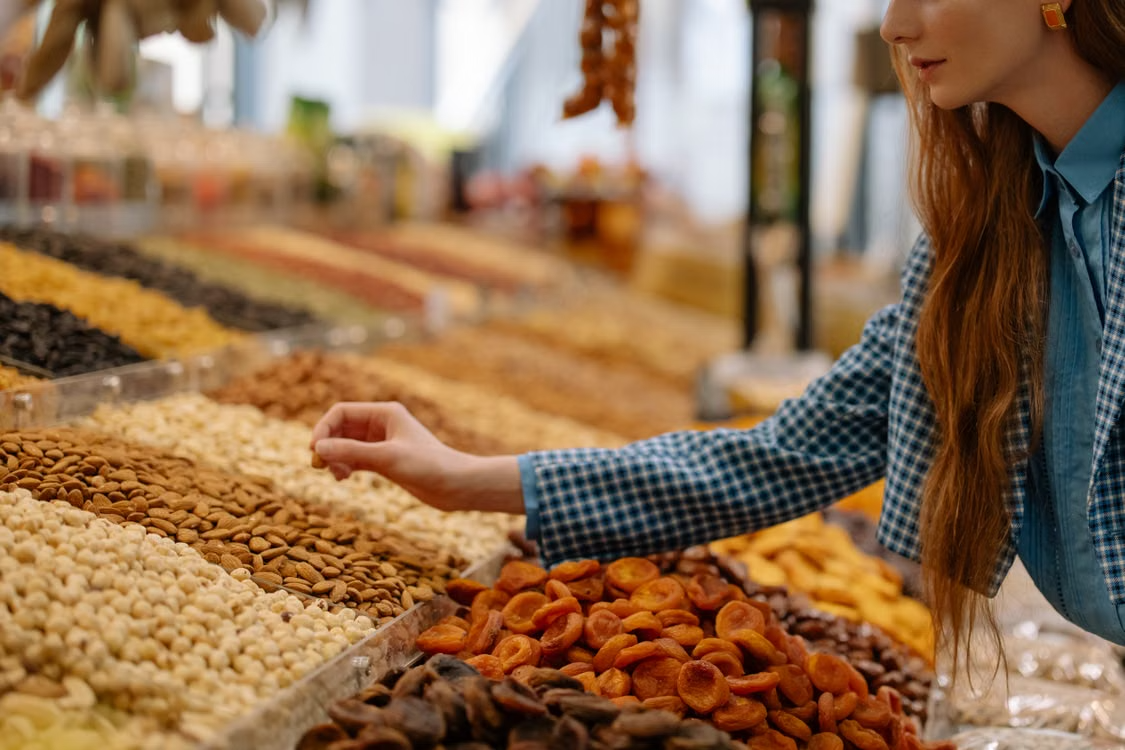
The best cashew nuts supplier is not necessarily the one offering the lowest FOB price. First define the end-use requirement: raw ingredient, roasting, snack retail, confectionery, nut butter, or another application.
Then establish kernel size, grade, whole/broken ratio, allowable defects, moisture, packaging, shelf life, testing requirements, and labeling information before comparing supplier quotations.
2. Verify processing and quality-control capabilities
A supplier should be able to explain where raw cashews are sourced, where shelling and processing occur, how lots are identified, and how finished-product inspections are performed.
Ask for representative samples and recent test reports rather than relying solely on marketing certificates. For recurring orders, evaluate whether the supplier can maintain comparable specifications across multiple production lots.
3. Evaluate food-safety documentation
A reliable supplier should be able to provide documentation supporting FDA-related importer requirements. Depending on the buyer's risk assessment, this can include food-safety plans, HACCP-based controls, laboratory testing, traceability procedures, corrective-action records, allergen information, and relevant facility documentation.
For U.S. importers operating under FSVP, these records can become part of the evidence used to verify the foreign supplier.
4. Compare landed cost, not just product price
Cashew nuts wholesale pricing should be evaluated together with packaging, inland transport, freight, insurance, customs clearance, inspection costs, duties, testing, and potential quality claims.
A supplier with a slightly higher unit price can be more competitive if it consistently meets specifications, minimizes rejected lots, and provides complete documentation for U.S. entry.
Quick Supplier Self-Check List
Before accepting a U.S. wholesale order, suppliers should be able to answer “yes” to the following:
- Product defined: Is the product clearly specified as in-shell, raw shelled, roasted, salted, flavored, whole, or broken?
- Size and grade agreed: Are W240, W320, count, grade, or buyer-specific specifications clearly stated?
- Quality controlled: Are defects such as insects, mold, rancidity, blanks, and shriveled kernels controlled and documented?
- Laboratory testing available: Can the supplier provide lot-specific testing for contaminants or other parameters required by the buyer?
- FDA requirements understood: Has the supplier determined whether its foreign facility must be registered with FDA?
- FSVP support ready: Can the supplier provide food-safety and supplier-verification records requested by the U.S. importer?
- Allergen information accurate: Does product and ingredient documentation correctly identify cashew as a tree-nut allergen?
- APHIS checked: For applicable products, has the supplier verified APHIS requirements for the exact origin and processing conditions?
- Customs information ready: Are HTS classification, origin, commercial invoice, packing list, and other entry documents prepared?
- Contract specification complete: Are quality limits, testing methods, inspection procedures, packaging, claims, and remedies agreed before shipment?
Conclusion
Entering the U.S. market with imported cashew nuts requires a combination of regulatory compliance and disciplined commercial sourcing. Suppliers should distinguish FDA food-safety responsibilities from APHIS plant-health requirements, verify current HTSUS treatment, and agree detailed quality specifications with buyers before shipment. The strongest cashew nuts supplier is one that can consistently deliver the required grade, document food-safety controls, support U.S. importer verification, and maintain reliable quality across wholesale orders.
FAQs
1. Should buyers ask for a product specification sheet before ordering cashews?
Yes. A product specification sheet helps both parties confirm the exact commercial requirements before production. It should identify the product form, kernel size or count, grade, acceptable defects, moisture target, packaging, shelf life, testing parameters, and any buyer-specific requirements. Using one agreed specification reduces misunderstandings when comparing quotations or evaluating delivered lots.
2. Can W-count alone determine whether a cashew shipment is suitable?
No. W-count mainly communicates whole-kernel size and does not describe the complete quality profile. Two suppliers offering the same W320 specification may differ in defects, moisture, color, breakage, microbiological results, or other characteristics. Buyers should therefore treat size as one part of the specification rather than using it as the sole purchasing criterion.
3. Why can two cashew suppliers quote different prices for the same W-grade?
A shared W-grade does not mean the two offers are commercially equivalent. Price can vary because of defect limits, whole-kernel percentage, moisture specifications, processing methods, testing requirements, packaging, origin, shipment terms, and consistency between lots. Buyers should compare quotations against the complete specification and landed cost rather than evaluating unit price alone.
4. Should the same cashew specifications be used for retail and food manufacturing?
Not necessarily. Retail products may place greater emphasis on appearance, uniform whole kernels, flavor, seasoning, and packaging presentation, while food manufacturers may prioritize functionality, breakage tolerance, particle size, and processing suitability. The intended application should therefore be established first, followed by product specifications that reflect how the cashews will actually be used.
5. What should a buyer compare when reviewing samples from different cashew suppliers?
Buyers should compare samples against the same written specification rather than relying only on appearance or taste. Useful comparison points include kernel size, whole-to-broken ratio, visible defects, color, moisture, odor, packaging condition, and laboratory results where applicable. Samples should also be evaluated for consistency with the production lot the supplier would actually ship.
6. When should APHIS import requirements be checked for a cashew shipment?
APHIS requirements should be confirmed before shipment planning is finalized, because plant-health conditions can depend on the commodity, processing status, and country of origin. Checking only the product name is not enough. Suppliers should verify the applicable conditions for the exact shipment and obtain any required permits or plant-health documentation before loading.



'/%3e%3cdefs%3e%3clinearGradient%20id='paint0_linear_1477_4631'%20x1='18.272'%20y1='0'%20x2='18.272'%20y2='35.3674'%20gradientUnits='userSpaceOnUse'%3e%3cstop%20stop-color='%23FF9F9F'/%3e%3cstop%20offset='1'%20stop-color='%23F15E5E'/%3e%3c/linearGradient%3e%3c/defs%3e%3c/svg%3e)
'/%3e%3cdefs%3e%3clinearGradient%20id='paint0_linear_1477_4633'%20x1='17.5'%20y1='0'%20x2='17.5'%20y2='35'%20gradientUnits='userSpaceOnUse'%3e%3cstop%20stop-color='%23E9C0EE'/%3e%3cstop%20offset='1'%20stop-color='%23CE57DC'/%3e%3c/linearGradient%3e%3c/defs%3e%3c/svg%3e)