
'%3e%3cpath%20d='M10%200C4.4772%200%200%204.4772%200%2010C0%2014.6896%203.2288%2018.6248%207.5844%2019.7056V13.056H5.5224V10H7.5844V8.6832C7.5844%205.2796%209.1248%203.702%2012.4664%203.702C13.1%203.702%2014.1932%203.8264%2014.6404%203.9504V6.7204C14.4044%206.6956%2013.9944%206.6832%2013.4852%206.6832C11.8456%206.6832%2011.212%207.3044%2011.212%208.9192V10H14.4784L13.9172%2013.056H11.212V19.9268C16.1636%2019.3288%2020.0004%2015.1128%2020.0004%2010C20%204.4772%2015.5228%200%2010%200Z'%20fill='black'/%3e%3c/g%3e%3cdefs%3e%3cclipPath%20id='clip0_601_545'%3e%3crect%20width='20'%20height='20'%20fill='white'/%3e%3c/clipPath%3e%3c/defs%3e%3c/svg%3e)

'%3e%3cpath%20d='M18.5195%200H1.47656C0.660156%200%200%200.644531%200%201.44141V18.5547C0%2019.3516%200.660156%2020%201.47656%2020H18.5195C19.3359%2020%2020%2019.3516%2020%2018.5586V1.44141C20%200.644531%2019.3359%200%2018.5195%200ZM5.93359%2017.043H2.96484V7.49609H5.93359V17.043ZM4.44922%206.19531C3.49609%206.19531%202.72656%205.42578%202.72656%204.47656C2.72656%203.52734%203.49609%202.75781%204.44922%202.75781C5.39844%202.75781%206.16797%203.52734%206.16797%204.47656C6.16797%205.42188%205.39844%206.19531%204.44922%206.19531ZM17.043%2017.043H14.0781V12.4023C14.0781%2011.2969%2014.0586%209.87109%2012.5352%209.87109C10.9922%209.87109%2010.7578%2011.0781%2010.7578%2012.3242V17.043H7.79688V7.49609H10.6406V8.80078H10.6797C11.0742%208.05078%2012.043%207.25781%2013.4844%207.25781C16.4883%207.25781%2017.043%209.23438%2017.043%2011.8047V17.043Z'%20fill='black'/%3e%3c/g%3e%3cdefs%3e%3cclipPath%20id='clip0_601_548'%3e%3crect%20width='20'%20height='20'%20fill='white'/%3e%3c/clipPath%3e%3c/defs%3e%3c/svg%3e)
Core Information Overview
Before diving into the complexities of the Indonesian market, here is a quick-reference guide to the essential elements of exporting liquid dairy to Indonesia.
Key Element | Details |
|---|---|
Product Category | Imported Milk / Liquid Milk — including Pasteurized Milk, UHT Milk, and Sterilized Milk |
Target Market | Indonesia |
Primary Regulatory Agencies & Official Portals |
|
Key Certifications & Approvals | BPOM ML Registration Number, Mandatory Halal Certificate (registered via SIHALAL), SNI compliance, Import Recommendation (RIPH), Import Certificate (SKI) |
Last Updated | July 2026 |
Indonesia’s Dairy Import Market Pain Points
Indonesia, Southeast Asia’s largest economy and the world’s most populous Muslim-majority nation, is experiencing a surge in demand for high-quality liquid milk. Rising disposable incomes, rapid urbanization, and a growing health consciousness are fueling consumption of pasteurized fresh milk, premium UHT milk, and value-added dairy beverages. For international dairy suppliers, this represents a strategic window of opportunity.
Yet the market’s potential is shaped by a critical domestic limitation: Indonesia’s local fresh milk production meets only about 20%–25% of national demand. The country relies heavily on imports to bridge this gap, making it a highly attractive destination for global exporters.
However, tapping into this demand is anything but straightforward. Overseas suppliers must navigate a uniquely restrictive “dual‑threshold” import regime. First, imported liquid milk must comply with strict Indonesian National Standards (SNI) and BPOM food safety requirements. Second, and equally critical, is the hard 2026 Halal certification deadline—a non-negotiable compliance milestone that will determine which products can legally remain on the market. Ignoring either of these dual barriers will lead to shipment rejections, financial loss, and a missed market window.
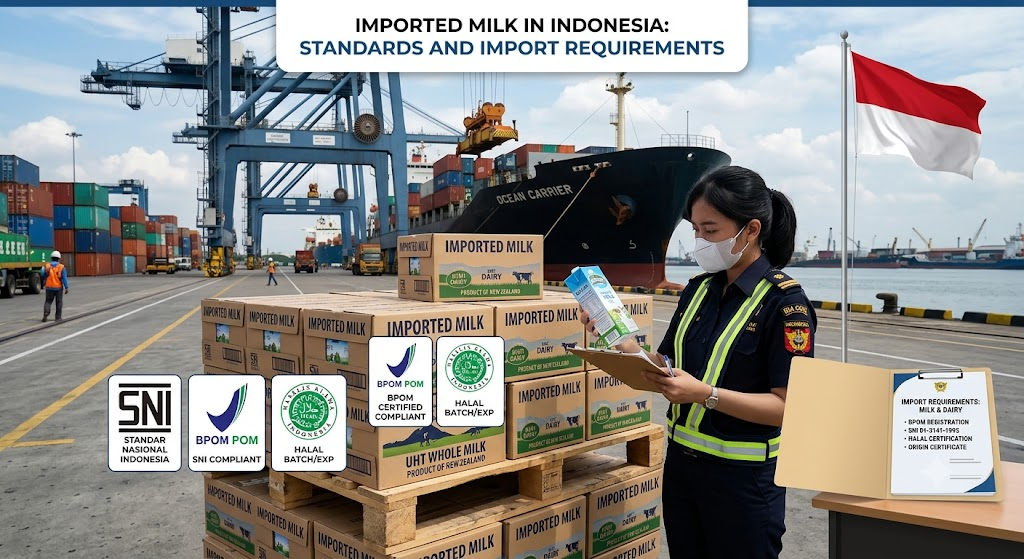
Indonesian National Standards (SNI & BPOM Standards) for Liquid Milk
Before any liquid milk can enter Indonesia, it must satisfy the physicochemical and microbiological indicators established by both BPOM and the Indonesian National Standards (SNI). These standards strictly dictate processing temperatures, minimum fat content, and solids-non-fat (SNF) ratios depending on your exact product category.
1. Pasteurized Milk Standards
Pasteurized milk must undergo a precise, mild heat treatment that preserves quality while eliminating pathogenic microorganisms. According to SNI 01‑3951‑1995, the accepted processing conditions are either a high-temperature short-time method (72°C–75°C for 15–20 seconds) or a low‑temperature long‑time method (62°C–65°C for 30 minutes), immediately followed by rapid cooling to below 10°C. The standard ensures that the physicochemical stability and nutritional integrity of the milk are maintained.
- Official Regulatory Standard: "Pasteurization in milk is processing by heating below the boiling point which aims to maintain the quality and standards of milk... such as High Temperature Short Time (HTST) technology, which heats milk to 72–75°C for 15–20 seconds, followed by rapid cooling... to maintain the physicochemical stability of the product." (Source: Badan Standardisasi Nasional - SNI 01-3951-1995)
2. UHT and Sterilized Milk Standards
For milk intended for ambient storage, BPOM mandates strict ultra-high-temperature processes and aseptic packaging to guarantee commercial sterility. Usually, this requires heating the milk rapidly to a minimum of 135°C for several seconds. The process guarantees a long shelf life at ambient temperature without the need for cold chain distribution.
- Official Regulatory Standard: "Liquid milk ready-to-drink UHT milk and sterilized milk must undergo thermal processing to achieve commercial sterility. Processing using Ultra High Temperature (UHT) typically involves rapid heating to a minimum temperature of 135°C for a few seconds and packaging aseptically." (Source: JDIH BPOM (Regulation on Food Category Standards)
Compliance with these standards is verified through laboratory testing during the BPOM registration process. Exporters must submit certificates of analysis demonstrating that their products meet the specified microbial limits (e.g., for Salmonella, coliforms, Aflatoxin M1) and compositional parameters (minimum fat content, solids‑non‑fat).
The "Fatal" Special Import Restriction on Retail Liquid Milk
This is the part of the regulation that catches many foreign exporters off guard. Indonesia’s Ministry of Agriculture, acting to protect local dairy farmers and domestic processing capacity, generally prohibits the direct import of retail‑ready, consumer‑packaged liquid milk. This includes pasteurized milk, UHT milk, sterilized milk, and sweetened condensed milk/creamer packed in 1‑liter or smaller retail formats destined for supermarket shelves.
- The Compliance Workaround: For international suppliers, liquid milk must generally enter Indonesia classified as a "Bulk / Industrial Input." This means exporting raw or bulk milk intended for local Indonesian dairy factories to undergo further processing, formulation, or repackaging. Exceptions for retail-ready imports are rarely granted unless the Indonesian government identifies a severe domestic supply shortage.
- Official Market Access Warning: "Indonesia's Ministry of Agriculture has advised importers to Indonesia it would stop issuing import recommendations for retail ready milk products including fresh (pasteurised) milk, liquid milk (UHT, sterilised and evaporated) and sweetened condensed milk/creamer. These products would only be allowed if they are to be used as an input for industrial production or for further processing in Indonesia. The justification given by the Ministry of Agriculture was that imports would only be allowed if domestic production was insufficient and/or products could not be produced domestically." (Source: Australian Government DAFF MICoR - Market Access Advice 2017-12)
For international dairy suppliers, this means that the product form, packaging size, and intended use must be clearly positioned as an industrial ingredient from the outset. Failure to structure the offering accordingly will result in an import recommendation (RIPH) being denied.
Halal Certification – The 2026 Hard Deadline and Dual‑Track Access for Foreign Suppliers
Halal certification in Indonesia is no longer just a marketing advantage—it is a strict legal barrier to entry. Indonesia’s Halal Product Assurance Law (Law No. 33 of 2014) has set a definitive compliance milestone. Following a transition period, Halal certification becomes mandatory for all imported food and beverage products—including liquid milk and its derivatives—on 17 October 2026. After this date, products without a valid Halal certificate registered with BPJPH cannot be distributed in Indonesia.
To obtain Halal compliance, foreign dairy suppliers can utilize a Dual-Track Access system:
Track 1: Registration of an Existing Foreign Halal Certificate (MRA Route). If your current Halal Certifying Body (HCB) in your home country has a Mutual Recognition Agreement (MRA) with Indonesia’s BPJPH, your local Indonesian importer can simply register your existing certificate electronically via the national SIHALAL portal. This avoids a redundant on‑site audit and significantly accelerates market entry.
Track 2: Direct Application for BPJPH Halal Certification. If your current certificate is not recognized, you must apply directly to BPJPH. This involves a full audit process, often including an on‑site inspection of the overseas manufacturing facility by Indonesian officials.
- Official Regulatory Standard: "Following a two-year delay, halal certification will become mandatory for all imported food and beverage products, including processed food and beverage products on 17 October 2026. The department understands halal certificates issued by BPJPH accredited foreign HCBs are required to be registered in BPJPH's online portal (SIHALAL). This must occur prior to the importation and distribution of products covered by these certificates within Indonesia." (Source: Indonesian Ministry of Religious Affairs - BPJPH Halal Information)
Given the tight deadline, overseas dairy exporters should initiate Halal registration procedures immediately, even if the product launch is planned for late 2026. Waiting risks capacity bottlenecks at BPJPH and delayed entry.
End‑to‑End Compliance Implementation – The 5-Step Guide for Importers & Exporters
Successfully bringing liquid milk into Indonesia requires a sequential, well‑documented process. International suppliers cannot handle this alone; they must collaborate closely with a qualified local partner.
- Step 1: Appoint a Qualified Local Nominee (Importer/Agent): Foreign entities cannot directly submit registrations to BPOM or BPJPH. You must appoint a legally registered Indonesian company holding an Import Identification Number (API) to act as the official registration holder and importer of record. A knowledgeable local partner is essential to manage regulatory submissions and customs clearance.
- Step 2: Overseas Dairy Facility Registration (Establishment Listing): Before product registration begins, the foreign manufacturing plant must be approved by Indonesia’s Ministry of Agriculture and Quarantine Agency. This “establishment listing” process verifies the facility’s compliance with good manufacturing practices, biosecurity standards, and traceability systems. An on‑site audit may be required.
- Step 3: Secure and Register Halal Certification: Working with your local partner, either register your existing foreign Halal certificate through SIHALAL (if an MRA is in place) or initiate a full certification application with BPJPH. This must be completed well before the October 2026 cutoff to ensure uninterrupted market access.
- Step 4: Obtain BPOM ML (Foreign Food) Registration: Submit the complete product dossier through BPOM’s registration system. The submission package must include detailed product composition, manufacturing flowcharts, HACCP or GMP certificates, lab test reports (microbiological, chemical, and nutritional), and a draft of the Bahasa Indonesia‑compliant label. Once approved, BPOM issues a 12‑digit “ML” registration number that must appear on the product packaging.
- Step 5: Apply for Import Quotas, Permits, and Clear Customs: The local importer must secure an Import Recommendation (Rekomendasi Impor Produk Hewan – RIPH) from the Ministry of Agriculture and an Import Permit (PI) from the Ministry of Trade. Upon shipment, customs clearance requires the BPOM Import Certificate (SKI), commercial invoice, packing list, bill of lading, batch‑specific Certificate of Analysis, and official health certificate. Critically, the goods must still have at least two‑thirds (2/3) of their total shelf life remaining at the port of entry, or the shipment may be rejected.
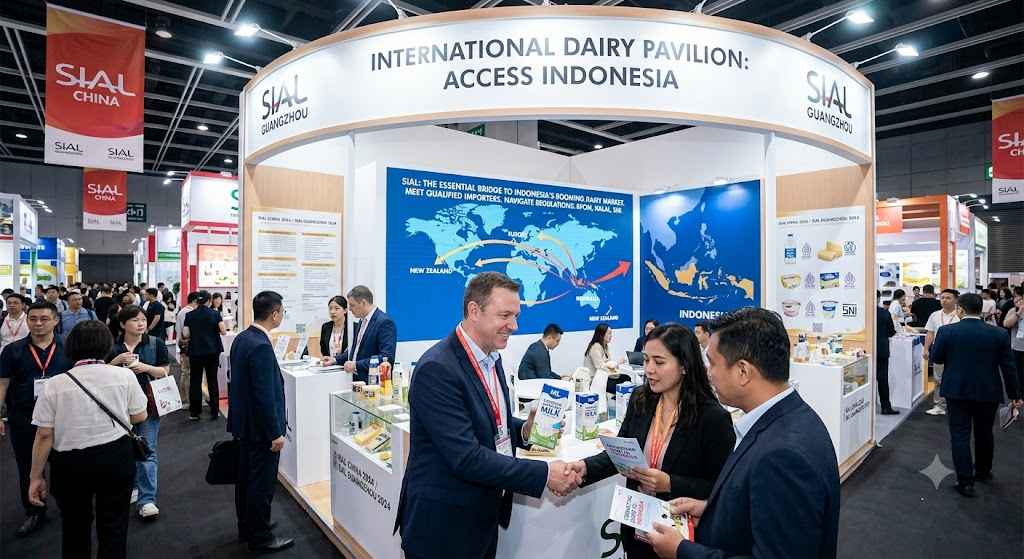
Conclusion & Foreign Enterprises Action Checklist
Indonesia’s liquid milk market offers extraordinary potential, but success hinges on two non‑negotiable realities: your product must be positioned as non‑retail industrial raw material, and you must secure Halal registration before 17 October 2026. Companies that align their strategy with these dual requirements early will gain a significant first‑mover advantage.
To move from planning to execution, international dairy suppliers should follow a concrete 30‑60‑90 day action plan:
- First 30 Days (Assessment):
- Evaluate your current liquid dairy catalog. Are you exporting bulk/industrial inputs, or retail-ready packaging? Pivot your strategy to bulk inputs if necessary.
- Verify your current Halal Certificate. Check if your Halal Certifying Body (HCB) is on BPJPH's approved MRA list.
- Day 31–60 (Partnerships & Registration Prep):
- Identify and sign an agreement with a qualified Indonesian local importer (Nominee) holding an active API license.
- Begin compiling your technical dossier for BPOM (manufacturing flowcharts, HACCP certificates, lab tests proving SNI compliance for temperatures and fat content).
- Day 61–90 (System Submissions):
- Have your local partner initiate your overseas facility registration with the Ministry of Agriculture.
- Officially submit your Halal certificate for registration in the SIHALAL portal to guarantee market access well ahead of the 2026 cutoff.
Proactive compliance is the key differentiator in Indonesia’s complex dairy import landscape. By aligning your technical, regulatory, and Halal strategy now, your brand can secure a sustainable foothold in one of the world’s most dynamic dairy markets.
Frequently Asked Questions
1. What documents are required to import milk into Indonesia?
Importing milk into Indonesia requires several vital documents. These include an active BPOM ML registration number, an Import Recommendation (RIPH) and Import Certificate (SKI), a commercial invoice, a detailed packing list, a batch‑specific Certificate of Analysis (CoA), a health certificate from the exporting country, and standard shipping documents such as the Bill of Lading.
2. Is Halal certification mandatory for imported milk products in Indonesia?
Yes, absolutely. Starting 17 October 2026, Halal certification will become a strict legal requirement for all imported food and beverage products—including liquid milk and its derivatives—before they can be distributed in Indonesia. International suppliers must ensure their products are either registered under an existing foreign Halal certificate (if a BPJPH‑recognized MRA is in place) or obtain a new Halal certificate directly through BPJPH.
3. Does imported milk need BPOM registration before entering Indonesia?
Yes. All imported processed dairy products must obtain a BPOM “ML” (Makanan Luar) registration number before they can be legally imported and commercially distributed. This process confirms the product meets Indonesia’s mandatory food safety, ingredient, and quality standards.
4. What are the labeling requirements for imported milk in Indonesia?
All imported milk products must follow Indonesian labeling regulations enforced by BPOM. Labels must be in Bahasa Indonesia and include the product name, ingredient list ordered by weight, allergen declarations, net volume, manufacturer and importer details, country of origin, expiration date, the BPOM ML registration number, and the official Indonesian Halal logo when applicable.
5. How can international dairy suppliers find Indonesian import partners?
International dairy suppliers can identify qualified Indonesian importers and distributors through B2B sourcing platforms, local industry associations, chambers of commerce, government trade promotion agencies, and international food trade exhibitions. Given the regulatory complexity, thorough due diligence is essential before selecting a local partner to ensure they hold an active API import license and have experience with dairy import permits and Halal registration procedures.


'/%3e%3cdefs%3e%3clinearGradient%20id='paint0_linear_1477_4631'%20x1='18.272'%20y1='0'%20x2='18.272'%20y2='35.3674'%20gradientUnits='userSpaceOnUse'%3e%3cstop%20stop-color='%23FF9F9F'/%3e%3cstop%20offset='1'%20stop-color='%23F15E5E'/%3e%3c/linearGradient%3e%3c/defs%3e%3c/svg%3e)
'/%3e%3cdefs%3e%3clinearGradient%20id='paint0_linear_1477_4633'%20x1='17.5'%20y1='0'%20x2='17.5'%20y2='35'%20gradientUnits='userSpaceOnUse'%3e%3cstop%20stop-color='%23E9C0EE'/%3e%3cstop%20offset='1'%20stop-color='%23CE57DC'/%3e%3c/linearGradient%3e%3c/defs%3e%3c/svg%3e)